FR-4 vs G10: Properties, Machining & How to Choose
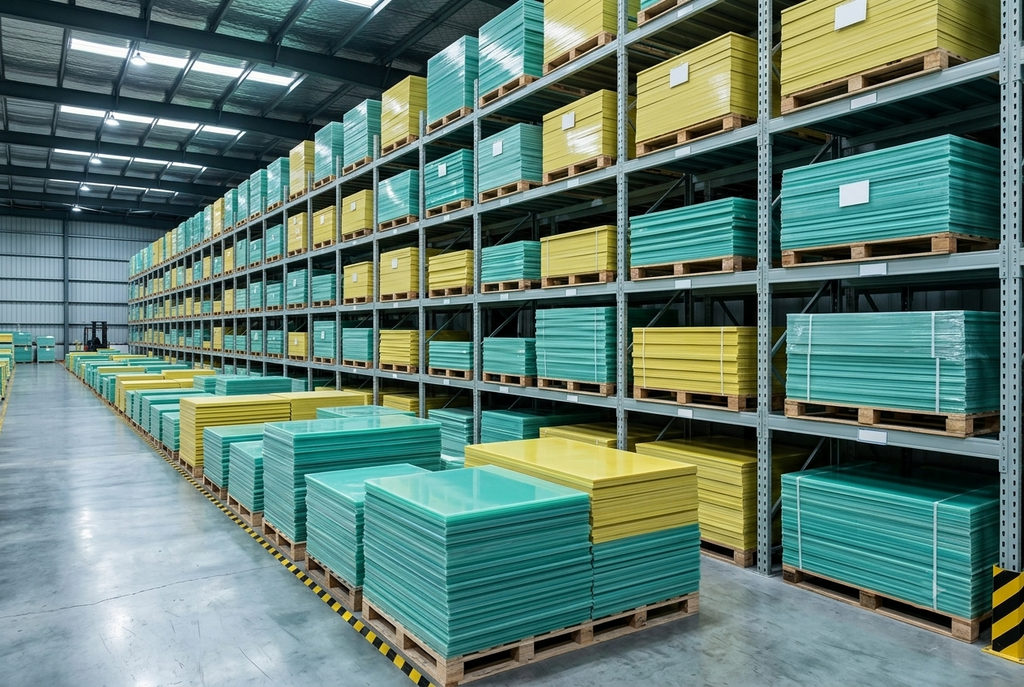
FR-4 is flame-retardant G10. Same woven glass fabric, same epoxy base — FR-4 just carries an additive package that lets it pass the UL94 V-0 burn test. That single fact resolves most of the fr4 vs g10 confusion before you read another line.

Here is the decision rule. Start with flammability. If your application has a flammability requirement — a UL listing, enclosed electronics, anything where a self-extinguishing rating is mandatory — specify FR-4. If it does not, G10 is usually the sound engineering choice, and often the better-performing one. That is the g10 vs fr4 question in a single sentence.
Most readers can stop there and spec correctly. The two materials are far closer than their separate names suggest, and the property gap is narrower than most spec habits assume.
If you need the full picture — where the numbers actually differ, how G11 and FR-5 fit above them, and how to avoid paying for a property your part never uses — the comparison below walks every axis that matters. Skip straight to the property table if you already know the basics and just need the data side by side.
What G10 and FR-4 actually are
Both are thermoset laminates. You take continuous woven fiberglass cloth, saturate it with epoxy resin, then cure it under heat and pressure into a rigid sheet. The glass carries the mechanical load. The epoxy binds the structure and provides the electrical insulation. This is the glass epoxy laminate family, and G10 is its reference grade.
The naming comes from NEMA, which classifies industrial laminates by grade letter. G10 is the NEMA designation for a woven-glass-fabric, epoxy-resin laminate with high mechanical and dielectric strength. FR-4 sits in the same NEMA system as the flame-retardant grade built on that same construction. So the two are not competing materials from different families. They are neighbors on the same grade chart.
This is also where the trade-name confusion starts. You will see G10 sold as Garolite, a common shorthand distributors use for glass-epoxy sheet. Garolite is not a separate material — it is a brand-style name covering G10, FR-4, and related grades. An engineer who specs "Garolite" and a buyer who quotes G10 may be talking about the same stock or two different grades, which is exactly how mis-specs happen.
The practical takeaway for g10 material selection: treat G10 and FR-4 as two configurations of one laminate system, then choose between them on requirements — not on habit or on whichever name the datasheet happened to use.

The core difference — flame retardancy
The real differentiator is in the name. The "FR" in FR-4 means flame retardant. FR-4 is formulated to meet UL94 V-0, the rating that requires a sample to self-extinguish within a defined time after the flame is removed, with no flaming drips that ignite the material below. G10 is not formulated for that. Standard G10 carries a UL94 HB rating — it will support combustion and is not self-extinguishing.
That rating gap is the entire reason FR-4 exists as a separate grade. The flame retardancy comes from an additive built into the resin system. Historically that meant brominated epoxy, a halogenated compound that interrupts combustion. Many modern FR-4 grades are halogen-free, using phosphorus-based chemistry to hit the same UL94 V-0 rating without bromine — relevant if your spec or your end market restricts halogens.
So when you choose FR-4, you are buying one property: a flame rating. Everything else — the glass reinforcement, the mechanical behavior, the dielectric performance — carries over from G10 largely intact. Hold that point. It is what makes the rest of the fr4 vs g10 decision an engineering judgment rather than a coin flip, and it is the reason over-specifying FR-4 wastes the additive cost on a property the part may never need.
FR-4 vs G10 property comparison
 Here is where the assumption breaks. Engineers expect FR-4 to be the "better" grade because it is the one with the burn rating. On the property axes that drive most designs, the two are close. The dielectric strength, the flexural and compressive strength, and the thermal limits track each other within a narrow band, because the underlying laminate is the same.
The dimensions worth comparing are dielectric strength, mechanical strength in flexure and compression, maximum continuous operating temperature, water absorption, and arc resistance / CTI. Those are the properties that decide whether a grade clears your design margins. Read the table by the fourth column — that is where each row tells you whether it should change your decision.
| Property | G10 | FR-4 | What it means for your spec |
|---|---|---|---|
| NEMA grade / classification | G10 | FR-4 | Both sit in the same NEMA glass-epoxy family; the grade letter, not the brand name, defines the material. |
| Reinforcement + resin | Woven glass + epoxy | Woven glass + epoxy | Identical base construction. The mechanical and dielectric behavior comes from this — and it is shared. |
| Flammability rating | UL94 HB | UL94 V-0 | The decisive difference. V-0 self-extinguishes; HB does not. If a flame rating is mandatory, this row alone selects FR-4. |
| Max continuous operating temp | Comparable to FR-4 | 170°C | Comparable for both. If you need a real margin above this band, G10/FR-4 is the wrong grade — go to G11/FR-5. |
| Dielectric strength (perpendicular) | Comparable to FR-4 | 16.5 kV/mm | Both are strong insulators in the same range. Rarely the deciding factor between the two. |
| Volume / surface resistivity | Comparable to FR-4 | Vol: 10^6 Ω×CM / Sur: 10^13 Ω | Comparable. Confirm against your insulation-resistance spec, not against the grade label. |
| Flexural strength | Comparable to FR-4 | 382 MPa | Close enough that FR-4 is not a mechanical upgrade. Do not spec it expecting more strength. |
| Tensile strength | Comparable to FR-4 | ≥300 MPa | Similar across both grades. |
| Water absorption | Comparable to FR-4 | <0.15% | Low for both. Check the actual figure if the part runs in humid or wet service. |
| Density / specific gravity | Comparable to FR-4 | 1.99 g/cm³ | Effectively the same — the additive does not change part weight meaningfully. |
| Machinability | Abrasive; machinable to tight tolerance | Abrasive; machinable to tight tolerance | Both are glass-loaded and abrasive. Edge quality on thin sections depends on tooling and feeds, not on which grade you picked. |
| Relative cost | Baseline | Premium for the flame-retardant additive | FR-4 costs more because of the additive package. Specifying it without a flammability requirement means paying for a property the part never uses. |
Every numeric value above is pulled from real material datasheets at the verification step.

Where G11 and FR-5 fit
G10 and FR-4 are not the top of the temperature ladder. When your continuous operating temperature pushes past their limit, you step up to G11 and FR-5.
G11 is the higher-temperature woven-glass-epoxy grade. Same construction principle as G10, but with a resin system that holds its mechanical and electrical properties at elevated temperature, giving it a higher maximum continuous operating temperature 180°C(356°F). It is the non-flame-retardant grade, the way G10 is.
FR-5 is to G11 what FR-4 is to G10 — the flame-retardant version, formulated to meet UL94 V-0 while keeping the higher thermal rating. So the four grades form a clean two-by-two: G10 and FR-4 at the standard temperature band, G11 and FR-5 above it, with the FR grades adding the burn rating in each pair.
The decision logic is the same one flammability question, asked at a higher temperature. If your part runs hot enough to need G11-class thermal performance and also carries a flame requirement, FR-5 is the grade. If it runs hot with no flame requirement, G11 is the value-correct choice. For everything inside the standard temperature band, you are back to the fr4 vs g10 decision.

How to choose — the decision framework
Work it in order. Each step either selects a grade or passes you to the next.
1. Is a flammability rating required? If your application demands a self-extinguishing material — UL-listed equipment, enclosed or densely packed electronics, anything where a regulatory or customer spec calls out UL94 V-0 — specify FR-4. The decision ends here, and it is the one case where the fr4 vs g10 question is not really a question.
2. Is there no flammability requirement? Then G10 is the default. It matches FR-4 on mechanical and dielectric performance, sometimes edges it out, and skips the additive. This is the most common mis-spec we see: a part with no flame requirement specified in FR-4 out of habit. FR-4 carries a price premium for its flame-retardant additive. Spec it where no flammability is needed and you are paying for a property the part never uses — while G10 performs equally well or better. Specifying the right grade here is an engineering and value decision, not a sourcing trick.
3. Check the temperature margin. If continuous service temperature exceeds the G10/FR-4 band, step up: G11 if no flame requirement, FR-5 if there is one.
4. Check electrical and mechanical margins. Confirm dielectric strength, CTI, and flexural/compressive values against your real design margins using verified datasheet figures — not the grade label. For the great majority of insulation and structural laminate parts, both grades clear comfortably.
That is the full g10 vs fr4 framework. Flammability first, temperature second, margins third, cost as the tiebreaker that usually favors the grade you were not in the habit of specifying.

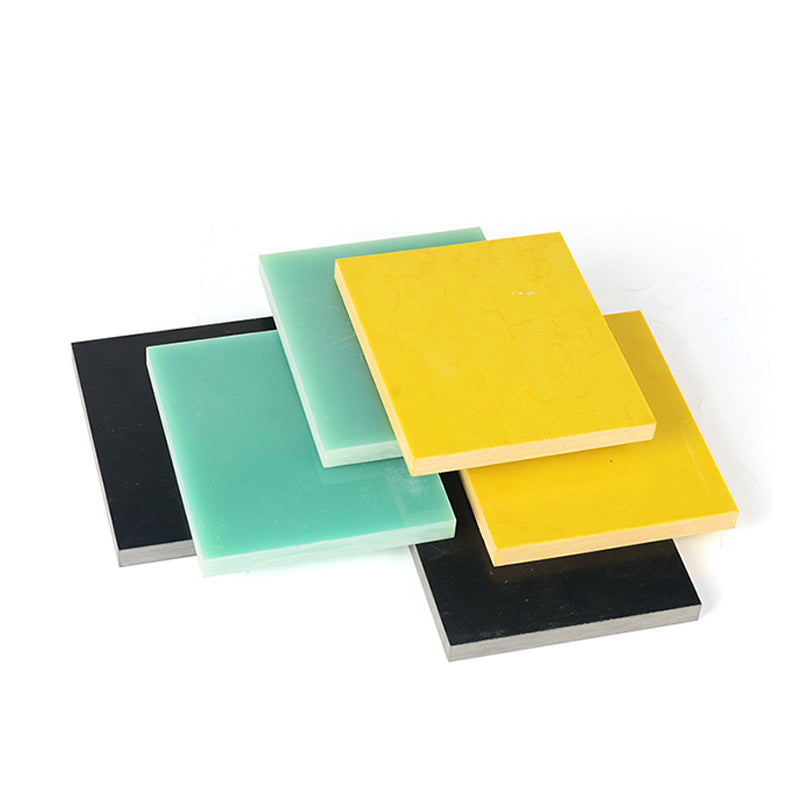
FR-4 / G10 Fiberglass Epoxy Sheets
In-stock FR-4 and G10 laminate sheets across common thicknesses — in aqua-green, yellow and black, available cut-to-size.
Machining FR-4 and G10
Both grades cut well — but only on a process built for them. Glass-epoxy laminate is abrasive. The woven glass fibers that give the material its strength also grind down cutting edges fast, so FR-4 machining and G10 machining demand the right tooling from the first pass. Solid carbide is the floor. For volume work and the cleanest edges, diamond-coated or PCD tooling holds up where carbide dulls. Tool wear is the hidden cost on this material, and a worn edge is what produces the chipping and fraying buyers worry about.
Feeds and speeds matter as much as the tool. Run too aggressive and you fracture the glass; run too slow and you generate heat that softens the resin and smears the cut. The FR-4 CNC process also has to manage workholding — the laminate must sit rigid and fully supported, or thin sheet flexes and the cut wanders. And the dust is abrasive and must be extracted at the source, both for edge quality and for the machine itself.
This is the practical reason process knowledge matters. A general shop that cuts mostly metal or the occasional plastic block tends to reach for the wrong tooling, burn through it, and hand back parts with chipped glass edges and ragged holes. Specialized laminate experience is what separates a clean, dimensionally stable part from a reject. Our CNC machining services are set up specifically for this material class.
Avoiding delamination, burring, and chipped glass edges
This is the recurring concern in procurement, and it is solved at the process level. When machining G10 material in thin sections, edge defects come from the wrong tool, wrong feed, or unsupported stock — not from the laminate itself. Sharp carbide or PCD tooling, conservative feed rates, the correct climb-versus-conventional strategy for the cut direction, and full backing under thin sheet keep the glass intact. Done right, edges come off clean, with no delamination at the layers and no burr to deflash.
Holding tolerances on thin sections and small features
Tight tolerances hold on small parts when the setup is right. We machine to ±0.03mm, which covers the close-fit holes, slots, and outside dimensions typical of insulating washers, spacers, and small brackets. The risk on thin laminate is real, but it is predictable: knife-edge features, undersized holes near an edge, or unsupported spans. That is what a free DFM review catches before any material is cut. Send a drawing or CAD file and we flag the at-risk features first, so the first article comes back right.

Parts we machine most in FR-4 and G10
The bulk of the work in these grades is insulation and structural support for electrical and electronic assemblies. The most common parts are insulating washers, standoffs and spacers, terminal boards, and busbar support boards — the components that hold conductors apart and keep clearances honest inside a panel or transformer. Structural brackets in glass-epoxy are common too, where a part needs dimensional stability and electrical insulation in one piece.
What ties these together is geometry: most are thin sections with features close to the edge, where edge quality is not cosmetic but functional. A frayed edge on a busbar support compromises creepage. A chipped washer cracks under clamp load. A burr in a terminal board hole interferes with assembly. These are exactly the parts where the machining process described above earns its place, and exactly the work our custom FR-4/G10 machining parts service is built around — single prototypes through production runs, with no minimum order quantity.
Custom-Machined FR-4 / G10 Parts
Send a drawing or CAD file and get a quote back in 24 hours — with a free DFM review and ±0.03 mm precision, from single prototypes to production runs.
Grades, sheet stock, and availability
Both grades are held in depth across the common thickness range, in the standard aqua-green, yellow, and black sheet. Large laminate stock on hand means quotes do not wait on sourcing, and there is no minimum order quantity — a single washer is as welcome as a full panel run.
Not every job needs full machining. If you only need flat sheet brought to a finished outside dimension, our cut-to-size service handles that directly, without the cost of a machined-feature quote. To check thickness and grade availability before you spec, browse our FR-4/G10 stock sheets and grades. Confirm the grade against your real requirement, then send the part.

FR-4 vs G10 FAQ
Are G10 and FR-4 interchangeable?
Often, but not always. If your application has no flammability requirement, G10 substitutes for FR-4 with equal or better performance. If a UL94 V-0 rating is specified, they are not interchangeable — only FR-4 carries the self-extinguishing rating. Check the flame requirement first.
Is FR-4 stronger than G10?
No. The flame-retardant additive does not add mechanical strength. Flexural, compressive, and tensile properties are comparable between the two grades because the woven-glass-and-epoxy base is the same. Specifying FR-4 expecting a stronger part is a common and costly mistake.
What does "FR" in FR-4 mean, and what is UL94 V-0?
"FR" means flame retardant. UL94 V-0 is the flammability rating requiring a sample to self-extinguish within a defined time after the flame is removed, with no flaming drips. FR-4 meets it; standard G10 carries the lower UL94 HB rating.
Is G10 the same as Garolite?
Garolite is a distributor trade name covering glass-epoxy laminate, including G10 and FR-4 — not a separate material. Specifying "Garolite" alone is ambiguous. State the NEMA grade (G10, FR-4, G11, FR-5) and any required flame rating so the quote matches the part.
When should I use G11 or FR-5 instead?
Step up when continuous operating temperature exceeds the G10/FR-4 band. G11 is the higher-temperature non-flame-retardant grade; FR-5 is its UL94 V-0 equivalent. Choose G11 with no flame requirement, FR-5 when both higher temperature and a flame rating apply.
Can thin G10/FR-4 parts be machined without delamination or chipped edges?
Yes, with the right process. Sharp carbide or PCD tooling, controlled feeds, the correct cut strategy, and full backing under thin sheet keep glass edges clean and layers intact. Edge defects come from the wrong setup, not the material.
What tolerances can you hold on small G10/FR-4 features?
We machine to ±0.03mm, which covers close-fit holes, slots, and outside dimensions on small parts like washers and spacers. At-risk features — knife edges, holes near an edge — are flagged in a free DFM review before cutting.

Get your part quoted
Spec the right grade, then send the part. Upload your CAD files or a drawing and you get a quote back within 24 hours, plus a free DFM review that flags any at-risk features before a single chip is cut. The work is backed by in-house material expertise, large laminate stock, and ±0.03mm precision on the thin, edge-critical parts these grades are used for. Start your custom FR-4/G10 machining quote and we'll confirm the grade fits the application before we make anything.
No minimum order · 24-hour quotes · Ships to the US, EU & Australia
-
Posted in
CNC machining, fr-4, FR-4 material, G10, Garolite, Glass Epoxy Laminates, Material Comparison